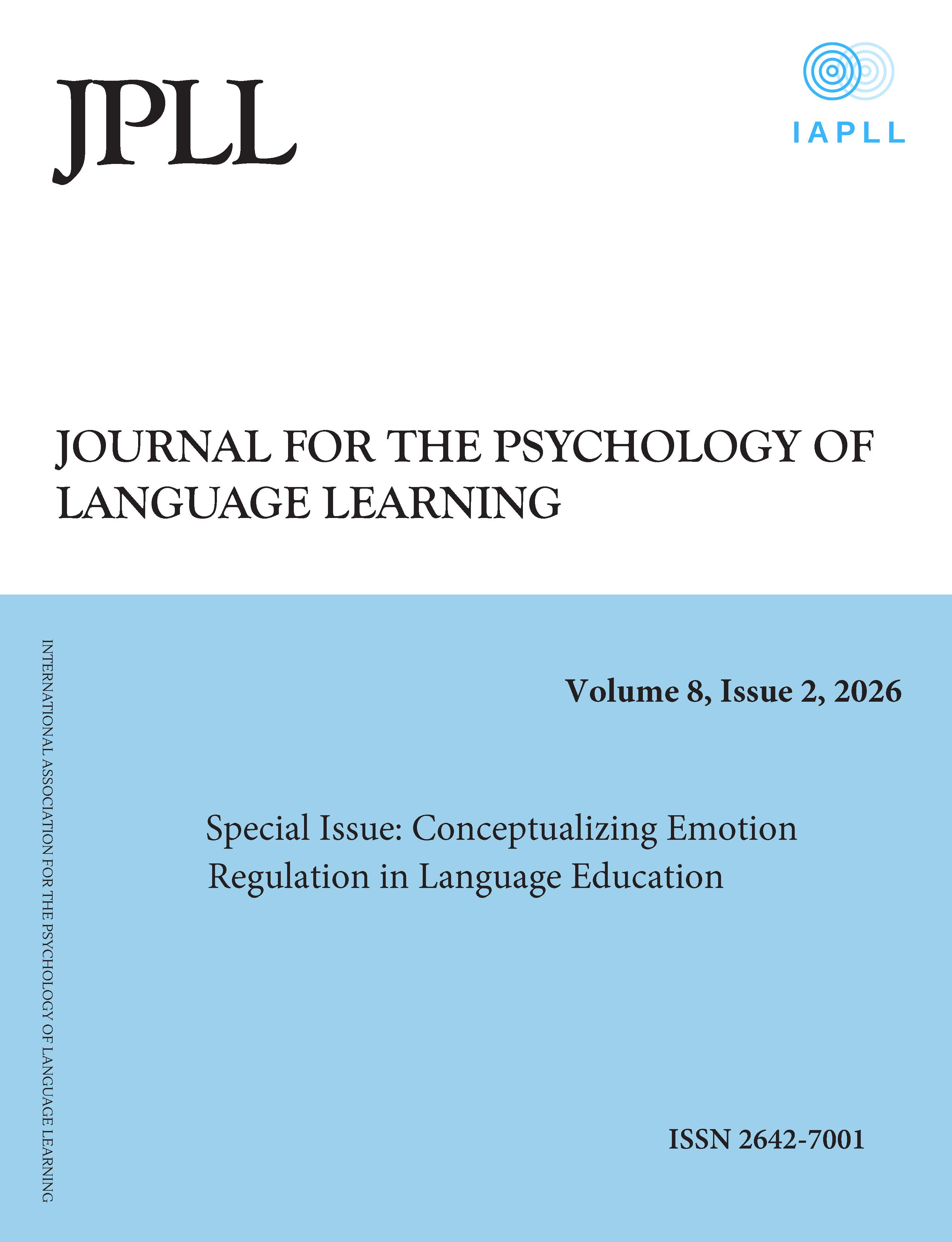
Introduction to the Special Issue
Conceptualizing Emotion Regulation in Language Education
Keywords:
emotional regulation, emotion regulation strategies, language teaching, language learningAbstract
Over decades of research in language learning and teaching, ample attention has been devoted to the diverse emotional experiences of teachers and learners, demonstrating how these emotions shape their well-being as well as teaching and learning processes. Yet insights into how teachers and learners regulate these emotions have remained scarce. This special issue aims to advance the field by providing a comprehensive picture of teacher and learner emotion regulation across diverse educational and sociocultural contexts. The studies adopt a range of methodologies and illustrate how emotion regulation is driven by different motives, unfolds in specific contexts and over time, and can be supported and enhanced through guidance. In this introductory paper to the special issue, we guide readers toward a foundational understanding of emotion regulation by highlighting three characteristics particularly salient in language education: its motivated, agentic, and context-sensitive nature. We then consider constructs related to emotion regulation and review current research highlighting its importance in language education. This is followed by an overview of the studies included in the special issue and, finally, a discussion of directions for future research.
Downloads
Published
Issue
Section
License
Copyright (c) 2026 Sachiko Nakamura, Sam Morris

This work is licensed under a Creative Commons Attribution-ShareAlike 4.0 International License.
The authors retain copyright over their work under a creative commons 4.0 agreement (CC-BY-SA). This means that authors are free to:
Share — copy and redistribute the material in any medium or format
Adapt — remix, transform, and build upon the material for any purpose, even commercially.
Under these terms:
Attribution — You must give appropriate credit, provide a link to the license, and indicate if changes were made. You may do so in any reasonable manner, but not in any way that suggests the licensor endorses you or your use.
ShareAlike — If you remix, transform, or build upon the material, you must distribute your contributions under the same license as the original.
No additional restrictions — You may not apply legal terms or technological measures that legally restrict others from doing anything the license permits.